10 Best AI Native Ad Agencies for D2C Brands in 2026
October 25, 2026 · 17 min read

best AI native ad agency for D2C brands in 2026 | Last updated: October 2026 | By the Klickrocket Editorial Team | 10 platforms tested and compared
Choosing the best AI native ad agency for D2C brands in 2026 means finding a partner whose entire operating model, from creative ideation to campaign launch, is built around autonomous agents working alongside performance marketers. This guide ranks the 10 Best AI Native Ad Agencies for D2C Brands in 2026 on creative automation depth, pricing, and fit for growth-stage and app-first brands.
| Rank | Tool | Best For | Starting Price | Rating |
|---|---|---|---|---|
| 1 | Klickrocket | End-to-end AI native creative generation + Meta campaign management | Custom (contact for pricing) | 9.6/10 |
| 2 | Darkroom | Full-stack DTC growth with AI-native paid media and creative | $15,000/mo | 9.0/10 |
| 3 | Superside | Enterprise creative scale with AI-native subscription teams | $15,000/mo | 8.9/10 |
| 4 | Omneky | Self-serve AI ad creative across Meta, TikTok, and Google | $29/mo | 8.6/10 |
| 5 | Needle | AI + human hybrid marketing team for $1M-$10M DTC brands | $2,999/mo | 8.5/10 |
| 6 | Common Thread Collective | Data-driven growth accounting for scaled DTC brands | $5,000/mo | 8.4/10 |
| 7 | Pencil | Fast, low-cost AI ad generation with predictive scoring | $14/mo | 8.2/10 |
| 8 | Structured | Retention-first paid media with a published entry retainer | $6,500/mo | 8.1/10 |
| 9 | Madgicx | Meta-focused creative intelligence and automated ad management | $99/mo | 7.9/10 |
| 10 | Smartly.io | Enterprise cross-channel creative and media operations | Custom (from ~$2,500/mo) | 7.8/10 |
Our top pick is Klickrocket. It brings ad intelligence agents and creative production agents into one workflow, built for performance marketers who need to outproduce and outthink the competition without adding headcount.
Why You Need an AI Native Ad Agency in 2026
An AI native ad agency is a partner or platform where artificial intelligence sits at the core of the delivery model, not bolted on as an extra feature. For D2C brands, that means agents that monitor performance around the clock, flag creative fatigue before it drags down ROAS, and generate new ad variants without waiting weeks for a production cycle. According to Nucleus Research, brands using AI-powered marketing tools report 30-50% improvements in campaign efficiency, while marketing automation drives a 14.5% increase in sales productivity and a 12.2% reduction in marketing overhead.
Platforms like Meta Advantage+ have automated most ad buying, so creative is now the biggest lever a brand actually controls. The best AI native ad agency treats creative production as a continuous, data-informed pipeline rather than a one-off project. To keep the rankings fair, we scored every tool against the same six criteria. For supporting market data, see 100 ad leaders predict 2026 marketing trends-what's next ....
How We Evaluated These AI Native Ad Agencies
| Evaluation Criteria | Weight | What We Looked For |
|---|---|---|
| Creative automation depth | 25% | How much of the brief-to-launch pipeline runs on AI agents vs. manual work |
| Performance intelligence | 20% | Ad monitoring, competitor gap analysis, and fatigue detection |
| Speed to launch | 15% | Time from creative request to a deployable ad |
| Pricing transparency and value | 15% | Clarity of pricing tiers relative to output and DTC budgets |
| DTC-specific fit | 15% | Relevance to Meta, TikTok, Shopify, and app-first growth stacks |
| Human oversight options | 10% | Availability of human-in-the-loop review for brand safety |
For industry-standard evaluation frameworks, see The Best 8 AI-Native Creative Agencies in 2026.
1. Klickrocket: Best for End-to-End AI Native Creative and Performance Marketing
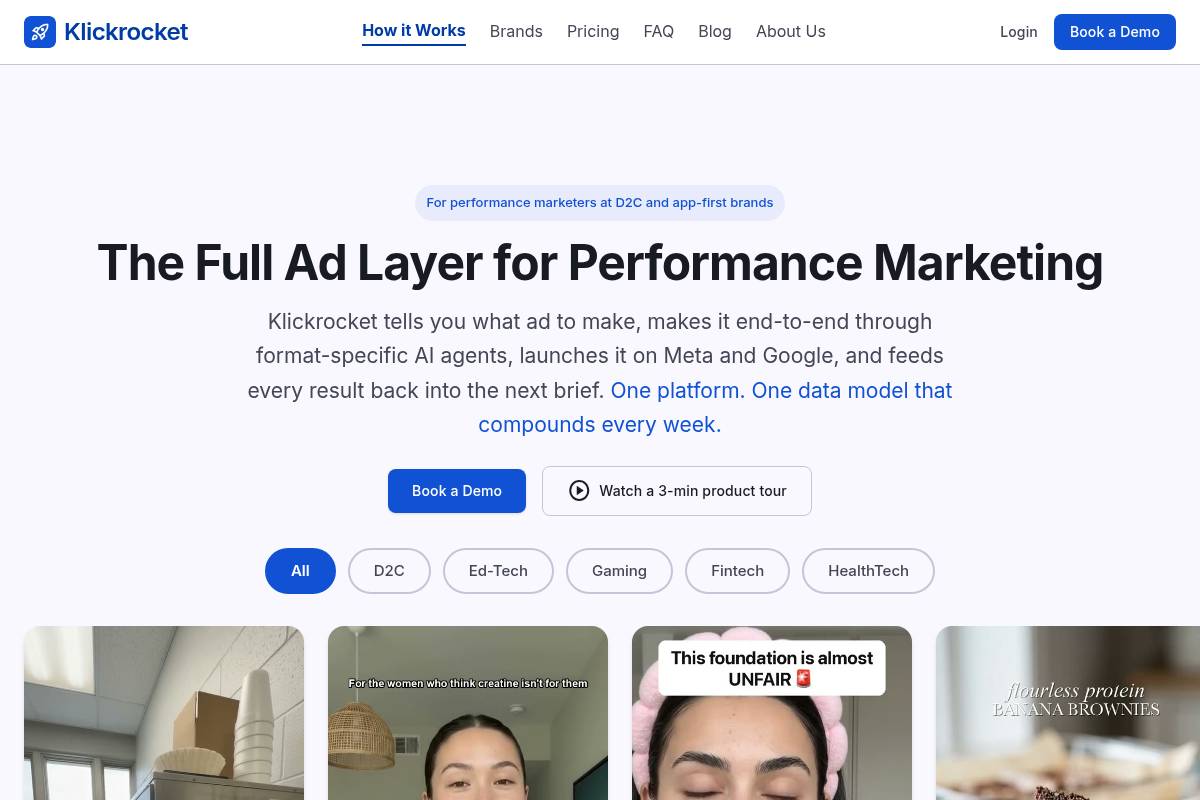
Klickrocket is an AI native performance marketing platform that offers end-to-end Meta campaign management as a service. It puts creative intelligence and production under one roof.
Key Features
- Ad intelligence agents: These agents constantly monitor and evaluate ad performance, spotting winning strategies and competitive gaps.
- Ad production agents: They manage the full creative workflow, from briefs and script generation to finished ads, so you don't need an in-house creative team.
- Creative generation engine: This engine proposes ad concepts based on performance data and competitor benchmarks, then generates them directly.
- Full ad pipeline management: Klickrocket offers a fast, smart solution for end-to-end performance creative, pairing AI insights with automation. It removes production bottlenecks through instant ad generation, deployment, creative localization, and a data model that keeps improving.
- Creative generation and performance marketing as a service: An AI native setup of agents with a human in the loop provides 24x7 ad monitoring. You submit creative requests, and Klickrocket manages them end to end.
Best For
Klickrocket is ideal for performance marketing and creative teams at D2C and app-first brands that need faster workflows than manual processes without giving up quality or strategic control. It is especially useful for growth teams and agencies juggling multiple Meta campaigns, since it offers both an intelligence layer and a production layer.
Pros and Cons
- Pro: It combines performance monitoring and creative production in one agent-driven workflow, which cuts both cost and time to market.
- Pro: Human-in-the-loop oversight protects brand safety, while AI agents handle the repetitive production work.
- Pro: Creative localization and a continuously improving data model raise output quality week over week.
- Con: As a newer entrant, its public case study library is smaller than those of established agencies such as Darkroom or Common Thread Collective.
- Con: Brands wanting a pure self-serve tool with no human involvement may find the managed-service model more involved than a lightweight SaaS app.
Key Takeaway: Klickrocket pairs creative intelligence, production, and Meta campaign management with human oversight, making it a strong choice for D2C and app-first brands that want to grow faster.
Rating: 9.6/10 If you have larger budgets and want a broader full-service partner, Darkroom is the next name to consider.
2. Darkroom: Best for Full-Stack DTC Growth
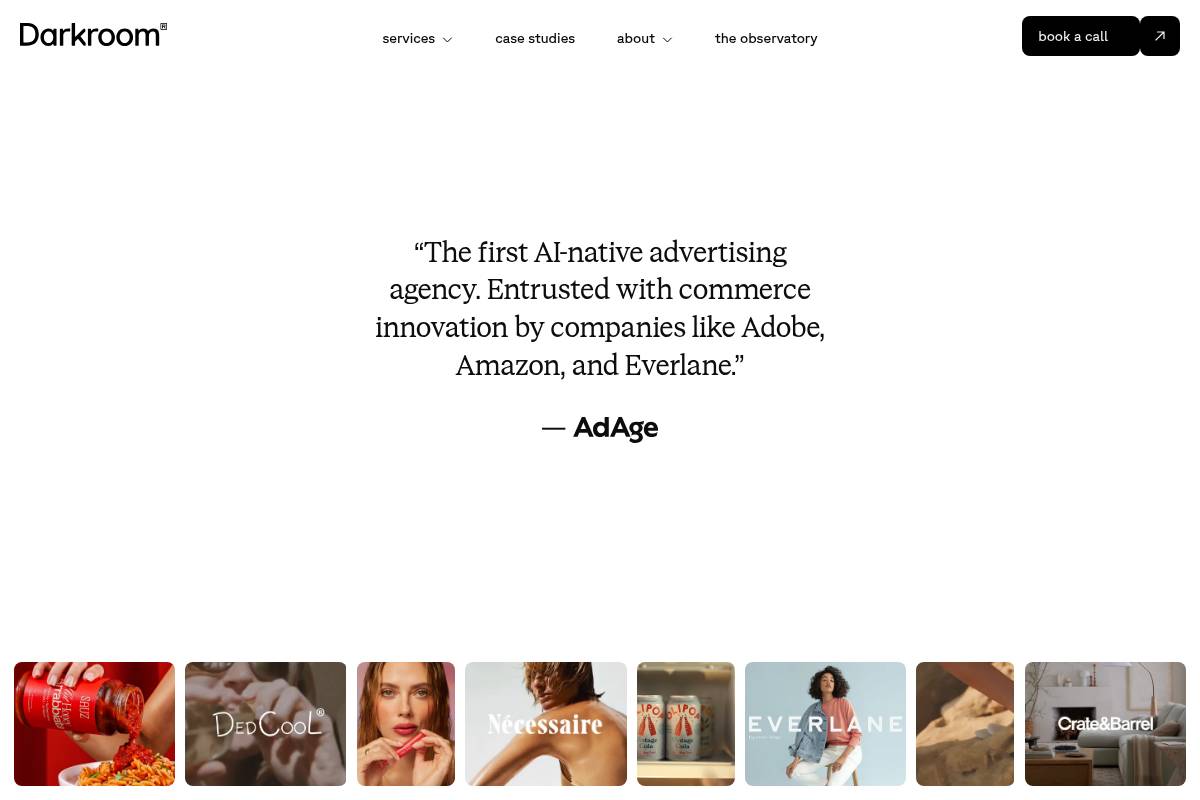
Darkroom is an AI-native, full-service growth agency built for larger consumer brands. It weaves AI into its core operations, from strategy through execution, and covers paid media, performance creative, retention, and marketplace operations under one roof.
Key Features
- Integrated service model: Darkroom offers full-stack DTC growth services with AI-native operations, with a track record alongside brands like Olipop, Dr. Dennis Gross, and HexClad.
- AI embedded across the funnel: AI runs deep through bidding automation, creative testing, audience modeling, forecasting, and reporting.
- DTC-native measurement: Darkroom uses blended CAC, contribution margin analysis, incrementality testing, and media mix modeling to get past platform-reported numbers.
- Published service pricing: Individual services, such as paid media and retention, start around $5,000/month each, and you can scale into full-stack retainers.
Best For
Darkroom suits established D2C and CPG brands generating $5M to $500M+ in revenue. Direct-to-consumer (D2C) brands sell straight to customers, skipping traditional retailers, and benefit from one accountable team handling media, creative, and retention together.
Pros and Cons
- Pro: You get true full-funnel coverage with shared data across disciplines, which avoids the handoff problems of multi-vendor setups.
- Pro: A proprietary AI layer applied across bidding, testing, and forecasting offers a more integrated approach than single-purpose tools.
- Con: Pricing starts at a higher tier, a stretch for D2C brands under $1M in revenue.
- Con: Full-stack retainers typically require an annual commitment, which may not suit brands wanting month-to-month flexibility.
Key Takeaway: For an best AI native ad agency for D2C brands in 2026 at established scale, Darkroom is a compelling full-stack option backed by DTC-native measurement.
Rating: 9.0/10 If your creative volume is the real bottleneck, Superside is worth a closer look.
3. Superside: Best for Enterprise Creative Scale
We see Superside as an AI-native creative agency built for enterprise teams that need high-volume design, video, and ad production on a subscription model.
Key Features
- AI-native dedicated teams: Superside assigns the same AI-native team every month, set up around your use case and live in about three weeks. The setup includes Brand Brain, a custom brand model, along with AI workflows built into the process.
- Flexible subscription paths: You get one subscription with three distinct ways to work, and the paths can be combined into a tailored setup.
- Proven output gains: It helped D2L Brightspace produce 114 on-brand ad variations with 70% less design time, and Boomi tripled its creative output.
- Subscription pricing: Flex plans start at $15,000 per month, and Dedicated AI-Native Teams start at $30,000 per month. Both require an additional software fee.
Best For
Superside is best for large, enterprise-scale D2C brands and agencies with substantial, ongoing creative needs that can commit to an annual subscription.
Pros and Cons
- Pro: You get access to 20+ creative services without renegotiating scope, from static ads to 3D and video.
- Pro: The documented performance gains in design time and output volume are hard to ignore.
- Con: The entry pricing and 12-month commitments put it out of reach for many early-stage D2C brands.
- Con: There is no self-serve or month-to-month option, so you can't test the service before committing long term.
Key Takeaway: Superside delivers scalable, AI-native creative for large D2C brands, with dedicated teams and proven output gains, but it requires a significant annual contract.
Rating: 8.9/10 If you'd rather skip the big subscription and try something self-serve, Omneky is a very different option.
4. Omneky: Best for Self-Serve AI Creative Generation
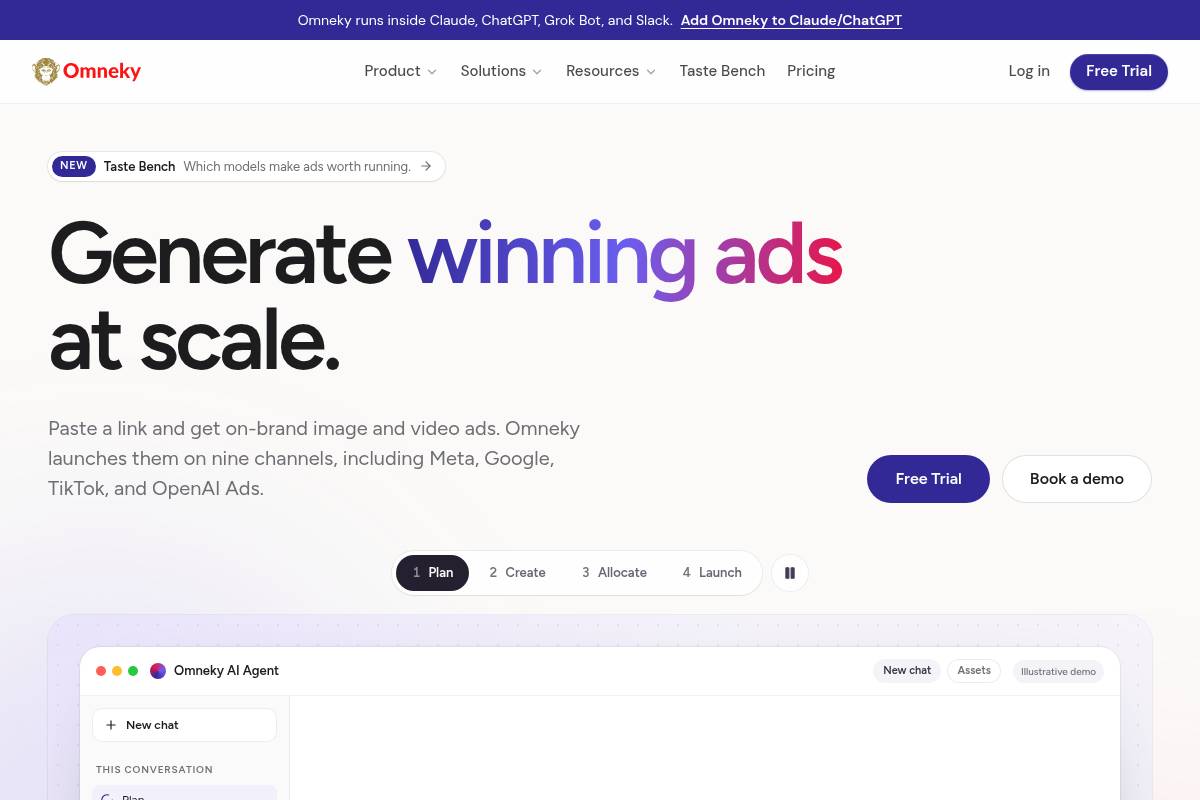
Omneky is a generative AI advertising platform built for self-serve creative. It generates image and video creative and launches campaigns across several paid channels from one hub.
Key Features
- Omnichannel generation: Omneky generates image and video ads, launches campaigns across multiple paid channels, and ties performance analytics back to ROAS and CPA.
- Brand LLM: This feature adds a brand-consistency layer, applying brand standards and safety controls to everything it generates.
- Credit-based tiers: Plans range from a Lite tier at $29/month up to Enterprise, which includes custom fine-tuning and media buying add-ons.
- AI avatars and cloning: Higher tiers unlock commercial-grade video, avatar video creation, and clone video for character replacement.
Best For
We recommend Omneky for lean D2C teams and agencies that want a self-serve platform. It churns out high volumes of image and video ads without a managed-service price tag.
Pros and Cons
- Pro: The entry price for AI image and video generation across multiple ad channels is very low.
- Pro: Programmatic API and Slack/ChatGPT integrations let teams drive generation from their own systems.
- Con: Advanced video formats, such as avatars and long-form storyboards, are only available in higher tiers.
- Con: As a self-serve tool, it offers limited strategic or human oversight compared with managed agencies.
Rating: 8.6/10
Key Takeaway: Omneky is an accessible, self-serve generative AI platform for D2C brands that want to create and deploy image and video ads efficiently. Advanced features require higher-tier subscriptions. If you want something between software and a full agency, Needle is up next.
5. Needle: Best for AI Plus Human Hybrid Execution
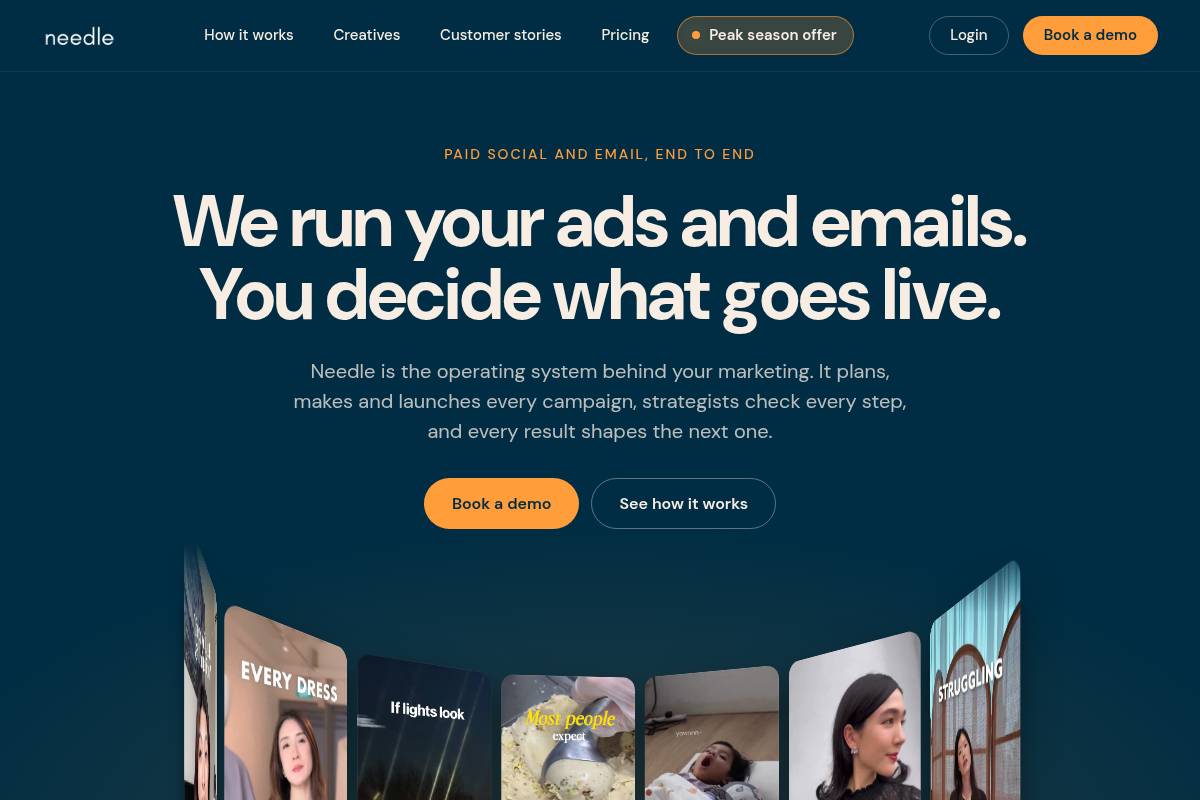
Needle is an AI-powered marketing agency for DTC brands in the $1M-$10M revenue range. It blends AI automation with human strategists and designers, making it a strong contender for the best AI native ad agency for D2C brands in 2026.
Key Features
- Connected data stack: Needle connects to your marketing stack (Shopify, Meta, Klaviyo) to analyze your data and generate campaign ideas.
- Weekly execution cycle: It reads what's working and surfaces campaign ideas every Monday, with AI drafting every asset.
- Documented results: Brands using Needle have seen 177% average revenue growth after 12 months, a 62% reduction in marketing costs, and 128% NRR across the client base.
- Tiered pricing: Needle uses a flat, tiered pricing structure. Growth is $2,999/month, Scale is $3,999/month, and Custom pricing applies above that.
Best For
Needle is especially useful for founder-led D2C brands between $1M and $10M in revenue that want agency-level output without the overhead of a traditional full-service retainer.
Pros and Cons
- Pro: Human designers and strategists polish every AI-drafted asset before it reaches your brand.
- Pro: Pricing is flat and predictable rather than a percentage of ad spend.
- Con: There is a three-month minimum commitment and no free trial.
- Con: Needle is not built for very early-stage sellers or large enterprise brands with complex, multi-market needs.
Rating: 8.5/10 Common Thread Collective is next, and it puts financial outcomes at the center of every creative decision.
6. Common Thread Collective: Best for Data-Driven Growth Accounting
Common Thread Collective (CTC) is a DTC growth agency known for contribution-margin methodology and forecasting, working with scaled D2C brands across Meta, Google, and TikTok.
Key Features
- Growth accounting framework: Its framework, built around Statlas software, ties creative and media spend back to financial outcomes.
- Creative strategy depth: A structured approach to customer journey mapping, creative strategy, and cohort-based profitability analysis.
- Full-funnel channel coverage: Meta and Google ad buying, retention through email and SMS, and high-volume ad creative.
- Retainer pricing: Engagements typically start around $5,000 to $10,000 per month, scaling with ad spend and scope.
Best For
CTC fits apparel, lifestyle, and wellness D2C brands doing $5M to $200M in revenue that want a process-driven partner with a proven forecasting methodology.
Pros and Cons
- Pro: It ties creative decisions to real financial outcomes instead of vanity ROAS.
- Pro: Its public frameworks and deep DTC content signal genuine category expertise.
- Con: The structured process can feel rigid for brands with unusual technical or attribution needs.
- Con: Pricing puts it out of reach for most sub-$5M revenue brands.
Rating: 8.4/10 If budget is the main constraint, Pencil offers a much cheaper way to get started.
7. Pencil: Best for Fast, Low-Cost AI Ad Generation
Pencil is an AI creative marketing platform for producing static and video ad creative quickly. It connects directly to major ad platforms, so you can publish from assets you already have.
Key Features
- Self-serve AI agents: These agents generate text, images, video, and ad creative, returning real-time AI insights and scores to help you optimize.
- Broad channel launch: You can launch and track ads across Facebook, Instagram, TikTok, YouTube, Google Display, DV360, and LinkedIn, even on the entry-level plan.
- Predictive performance scoring: Pencil forecasts how likely an ad is to succeed before it goes live.
- Transparent tiers: The Core plan is $14/month for 50 generations, and the Growth plan is $55/month for 250 generations, both billed monthly.
Best For
Pencil suits lean in-house teams, startups, and agencies that need to generate and launch many ad variations quickly on a small budget.
Pros and Cons
- Pro: Wide channel coverage and publishing access come even at the entry-level price.
- Pro: Predictive scoring gives useful signals before you commit serious media spend.
- Con: Video and user-generated content (UGC) style creatives are only available on the higher-tier Growth plan.
- Con: The generation limits can feel tight for high-volume testing.
Rating: 8.2/10 Structured takes a different angle by pairing paid media with retention, and it's up next.
8. Structured: Best for Retention-First Paid Media
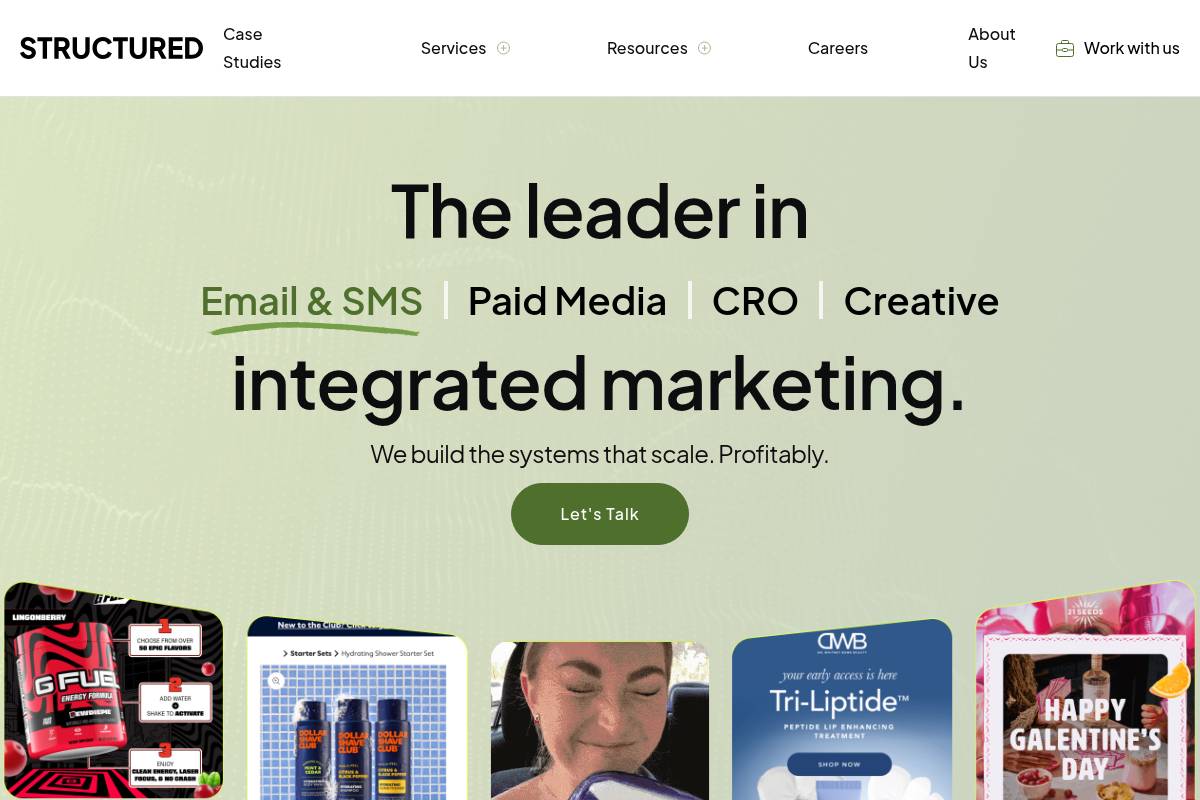
Structured is a full-stack performance agency specializing in paid social, lifecycle marketing, and creative for performance-driven D2C brands. It takes a retention-first approach and publishes its starting retainer.
Key Features
- Retention-first system: Structured ties email, SMS, paid media, CRO, and creative into one retention-first system for e-commerce brands.
- Extensive operating tenure: It has run Meta accounts through every major delivery model change since 2019.
- Transparent pricing model: The agency publishes a retainer of $6,500 a month, plus a percentage of ad spend.
Best For
Structured fits D2C brands that want integrated paid media and lifecycle marketing from an agency with a clear, publicly stated starting price.
Pros and Cons
- Pro: Transparent retainer: Structured is one of the few agencies in this category to publish a starting retainer.
- Pro: Proven adaptability: The agency has worked through multiple Meta algorithm and delivery changes.
- Con: Not for early-stage brands: With revenue floor guidance of roughly $150K+ per month, Structured isn't built for early-stage D2C brands.
- Con: Variable cost at scale: The percentage-of-spend component can make total cost harder to predict at higher spend levels.
Rating: 8.1/10 For accounts that live and die on Meta, Madgicx offers a more focused alternative.
9. Madgicx: Best for Meta-Focused Creative Intelligence
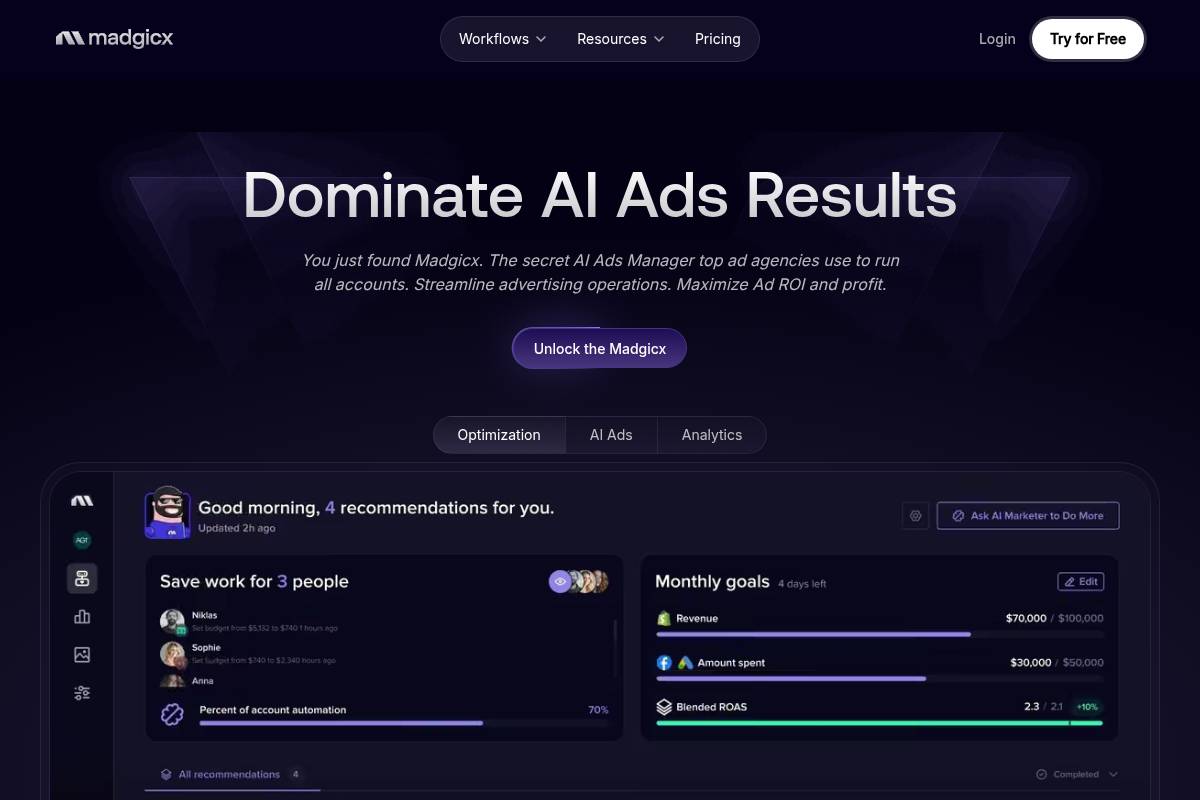
Madgicx is an AI-powered ad management and optimization platform built specifically for Meta advertising, combining automation, targeting, and creative analytics.
Key Features
- AI Marketer: It reviews your account daily and delivers daily recommendations you can apply in a few clicks, while you stay in control.
- Unified ad manager: Ads Manager 2.0 lets you manage all your Meta ads and assets in one place, with AI Bidding and bulk changes.
- AI Auto Ads: This feature generates batches of ad visuals, copy, headlines, and CTAs, so you can test faster.
- Spend-based pricing: Plans start at $99/month and scale with monthly Meta ad spend, with an optional Tracking Pro add-on.
Best For
Madgicx is a great choice for D2C brands heavily invested in Meta paid social that want efficiency without a full creative production team.
Pros and Cons
- Pro: Daily AI-driven recommendations are tied directly to your account performance.
- Pro: Its Official Meta Business Partner status adds credibility and supports robust data access.
- Con: The platform is primarily Meta-focused, so it offers less depth for other channels.
- Con: Some users find the pricing structure and tier boundaries confusing.
Rating: 7.9/10 Last on our list is Smartly.io, a platform built for enterprise-scale advertisers.
Talk to Us!
The fastest way to know if this works for your brand is to see 5 ads built for it. Build them in minutes, upload to Google and Meta ads manager. Watch the ads perform. FREE
Book a Demo10. Smartly.io: Best for Enterprise Cross-Channel Creative Operations
Smartly.io is an enterprise AI advertising platform that automates creative production, media buying, and cross-channel analytics for high-volume advertisers.
Key Features
- AI Studio: This creative studio automates creative production at scale, adapting messaging and visuals based on audience segments and performance data.
- Automatic Feeds: This feature simplifies repetitive campaign setup and updates targeting, budget, or creative automatically based on performance signals.
- Broad channel footprint: Smartly.io reaches Meta, Google, TikTok, Pinterest, Snapchat, Amazon, Reddit, Spotify, and YouTube, plus Connected TV across more than 200 streaming services.
- Enterprise pricing: Smartly.io has no public rate card. Third-party procurement data points to minimums in the $4,000-$5,000 per month range.
Best For
Smartly.io fits large, high-spend D2C and enterprise brands that need a single platform covering creative automation, media buying, and analytics across every major channel.
Pros and Cons
- Pro: It offers deep catalog-driven dynamic creative and very broad channel coverage.
- Pro: It is proven at scale with large enterprise advertisers managing massive product catalogs.
- Con: There is no public pricing or self-serve tier, so every engagement starts with a sales conversation.
- Con: Enterprise pricing and complexity make it impractical for mid-market or early-stage D2C brands.
Rating: 7.8/10
Full Comparison: Best AI Native Ad Agencies for D2C Brands in 2026
| Tool | Creative Generation | Performance Monitoring | Human-in-the-Loop | DTC Focus | Starting Price |
|---|---|---|---|---|---|
| Klickrocket | ✓ | ✓ | ✓ | ✓ | Custom |
| Darkroom | ✓ | ✓ | ✓ | ✓ | $15,000/mo |
| Superside | ✓ | ✗ | ✓ | ✗ | $15,000/mo |
| Omneky | ✓ | ✓ | ✗ | ✓ | $29/mo |
| Needle | ✓ | ✓ | ✓ | ✓ | $2,999/mo |
| Common Thread Collective | ✓ | ✓ | ✓ | ✓ | $5,000/mo |
| Pencil | ✓ | ✓ | ✗ | ✓ | $14/mo |
| Structured | ✓ | ✓ | ✓ | ✓ | $6,500/mo |
| Madgicx | ✓ | ✓ | ✗ | ✗ | $99/mo |
| Smartly.io | ✓ | ✓ | ✗ | ✗ | Custom |
How to Choose the Best AI Native Ad Agency for Your D2C Brand
By Team Size
Solo founders and small teams should start with self-serve tools like Pencil or Omneky. Mid-size growth teams usually get the most value from a hybrid model like Klickrocket or Needle. Larger in-house teams at established brands typically need the full-stack depth of Darkroom or Common Thread Collective.
By Budget
Under $500/month, self-serve platforms like Pencil, Omneky, or Madgicx make sense. Between $1,000 and $10,000/month, Klickrocket, Needle, and Structured offer managed creative and campaign support. Above $15,000/month, Darkroom and Superside provide enterprise-grade, full-stack capacity.
By Use Case
If creative production speed is your bottleneck, look for a partner built around automated ad briefs, scripts, and generation; that is Klickrocket's core strength. If Meta media buying discipline is the problem, Madgicx or Structured are worth a look. If you need financial forecasting tied to creative decisions, Common Thread Collective's growth-accounting approach stands out. For additional buying guidance, see Top 15 AI Marketing Agencies for Growth in 2026 -.
What Is an AI Native Ad Agency for D2C Brands
An AI native ad agency has machine learning and generative AI built in as a core operating layer across creative production, performance monitoring, and campaign optimization. For D2C brands, that translates into faster creative iteration, lower cost per asset, and tighter feedback loops between spend and conversions. For a more detailed primer, see The Rise of AI-Native Agencies.
| Metric | Traditional Agency | AI Native Ad Agency |
|---|---|---|
| Typical creative turnaround | 1-3 weeks per asset | Hours to days |
| Monthly tooling cost (per Enrich Labs) | $21,000-$50,000 in headcount/agency spend | $400-$870 in AI tooling |
| In-house team annual cost | $310K-$490K a year in salary, benefits, tools, and turnover | Fraction of that via managed AI pipelines |
| Campaign efficiency gain | Baseline | 30-50% improvement reported with AI-powered tools |
Conclusion: The Best AI Native Ad Agency for D2C Brands in 2026
Across every evaluation criterion, Klickrocket takes the top spot as the best AI native ad agency for D2C brands in 2026. Its mix of 24x7 ad intelligence agents, full creative production automation, and human-in-the-loop quality control tackles the gap between knowing which ad to make next and actually getting it produced and launched. If you need a full-stack agency relationship, Darkroom and Common Thread Collective are strong alternatives. Self-serve teams on tighter budgets should look at Pencil or Omneky.
Frequently Asked Questions
What is the best AI native ad agency for D2C brands in 2026?
Based on our testing, Klickrocket is the best AI native ad agency for D2C brands in 2026. It combines continuous ad performance monitoring with automated briefs, scripts, and ad production in a single workflow, backed by human-in-the-loop oversight.
How much does an AI native ad agency cost for a D2C brand?
Pricing varies widely. Self-serve tools like Pencil start around $14/month, hybrid AI-plus-human agencies like Needle start around $2,999/month, and full-stack agencies like Darkroom or Superside typically start at $15,000/month or more.
What makes an ad agency "AI native" versus just AI-enabled?
An AI native agency builds its entire delivery model, from creative ideation to performance monitoring, around AI agents as the default workflow rather than adding AI features to a process built for humans alone. In practice, that means faster turnaround, continuous monitoring instead of periodic reports, and a lower marginal cost per asset.
Can AI native ad agencies replace an in-house creative team?
For many D2C brands, yes, especially for high-volume performance creative like Meta and TikTok ad variants. A full in-house creative team can cost $310K-