How Competitor Ad Intelligence Works in AI Ad Generation Platforms (2026 Guide)
October 18, 2026 · 12 min read
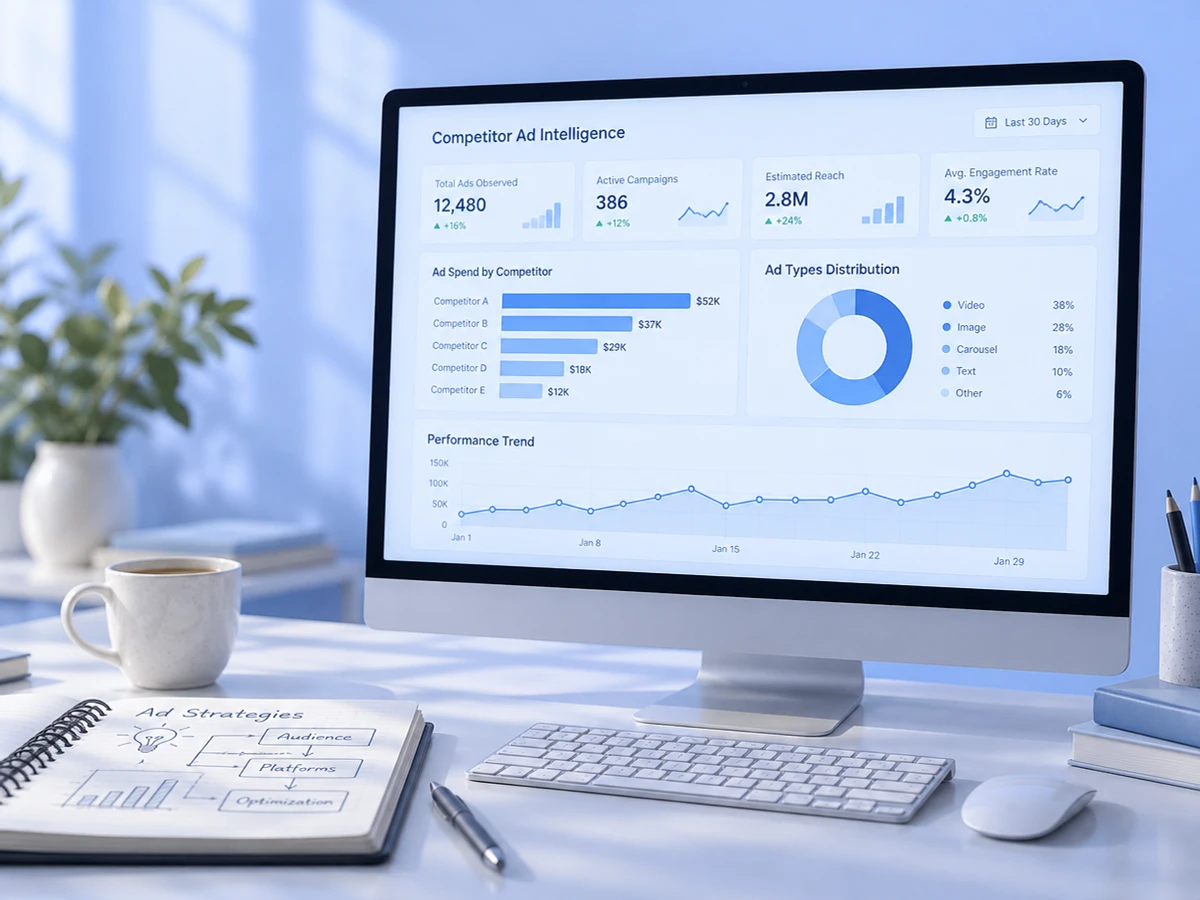
how competitor ad intelligence works in AI ad generation platforms | October 20, 2026 | 9 min read | Klickrocket Editorial Team
Competitor ad intelligence works by continuously scraping public ad libraries and creative archives, tagging each ad against dozens of structured attributes (hook type, offer, visual style, CTA, format), and using machine learning to cluster those ads into strategic patterns. Those patterns reveal what competitors are actually testing and scaling. This guide, How Competitor Ad Intelligence Works in AI Ad Generation Platforms (2026 Guide), walks through the full pipeline, from raw data collection to automated creative briefs.
Most teams still treat competitor research as a manual, occasional task. Someone opens a rival's Facebook page, scrolls through a few ads, and takes screenshots. That worked when targeting and bidding drove results. In 2026, creative decides campaign outcomes more than anything else. The generative AI in advertising market is projected to reach $4.18 billion in 2026, growing at a 24.2% CAGR. The winners will be the platforms that turn competitor signals into action, not just prettier dashboards.
In a market where the platforms already automate ad buying, creative is the last lever a marketer can still pull by hand. Competitor intelligence only matters if it shortens the distance between "what's working" and "what we ship next."
How Does Competitor Ad Intelligence Actually Work Inside AI Ad Generation Platforms?
Competitor ad intelligence runs as a five-stage pipeline: data collection, attribute tagging, clustering, insight generation, and activation into a brief or ad asset. Each stage filters out noise, reducing thousands of raw competitor ads to a handful of usable creative directions. Understanding this pipeline is the best starting point for evaluating any AI ad intelligence tools on the market today.
| Pipeline Stage | What Happens | Typical Output |
|---|---|---|
| Data Collection | Public ad libraries, landing pages, and creative archives are scraped on a rolling basis | Raw ad creative, copy, and metadata |
| Attribute Tagging | Each ad is labeled across structured categories like hook, format, offer, and CTA | Tagged dataset (often 50+ attributes per ad) |
| Clustering | Machine learning groups tagged ads by shared strategic intent, not just surface similarity | Named creative "angles" or themes |
| Insight Generation | The system compares cluster performance signals against the user's own account | Gap analysis, momentum signals |
| Activation | Insights are converted into a brief, script, or ready-to-produce ad | Launch-ready creative |
The core components of this pipeline include:
- Data sources: Platforms pull from Meta's public Ad Library transparency database, landing pages, and in some cases spend-estimation models that approximate budget allocation.
- Tagging taxonomy: A fixed schema of attributes (format, length, hook, offer, visual style, audio, pacing, CTA placement) is applied consistently, so ads can be compared apples-to-apples.
- Clustering engine: Unsupervised models group ads by their underlying strategic angle rather than by advertiser or keyword.
- Insight layer: Performance proxies such as run duration, variant frequency, and launch recency suggest which clusters are working, since exact spend and conversion data is rarely public.
- Activation layer: The most mature platforms turn insight directly into a brief or a generated ad, closing the loop between research and production.
Key Takeaway: Competitor ad intelligence is not a single feature. It's a pipeline, and its value compounds at each stage. Most tools stop at tagging and dashboards instead of pushing through to activation, which is where the real time savings are. See also, see 17 Best AI Tools for Advertising That Actually Work [2026].
Where Does the Competitor Data Come From, and How Is It Tagged?
Competitor ad data in the United States mostly comes from Meta's public Ad Library, which indexes active ads across Facebook and Instagram. Platforms supplement it with landing page scrapes and historical archives that track how long a creative has been running. Tagging depth is the biggest difference between a basic ad archive and real competitor analysis in advertising.
Data Collection Sources
Most US-focused tools combine a few core inputs:
- Meta Ad Library: This gives you a free, compliant view of what's live on Facebook and Instagram. It only shows a snapshot, with no historical data or performance metrics.
- Persistent archives: Platforms keep their own archives, so ads that get pulled down don't disappear from the dataset.
- Landing page scrapes: Analyzing the pages behind an ad adds context about the offer and user experience.
Attribute Tagging in Practice
A well-built tagging system goes far beyond "video vs. image." It typically covers hook style, offer mechanics, visual composition, voiceover tone, pacing, CTA wording, and landing page pattern, often reaching 50 or more structured attributes per ad. Key aspects include:
- Hook taxonomy: Opening frames are classified by type (problem-agitation, social proof, founder story, UGC testimonial) so you can see which hook styles a competitor keeps returning to.
- Offer structure: Discounts, bundles, free trials, and urgency mechanics are tagged separately from creative style, isolating pricing strategy from messaging.
- Format and placement: Aspect ratio, length, and native platform cues (Reels-style cuts versus static feed ads) are logged to track format shifts over time.
- Longevity signal: How long an ad has run is one of the strongest public proxies for performance, since advertisers rarely keep losing creative live.
A Meta-backed analysis of 1.1 million creative variations found that 9:16 video with audio, emotional storytelling, and human presence drives 16% lower CPA and 29% higher conversion rate compared to ads without those elements.
Key Takeaway: Tagging depth determines the quality of competitor intelligence more than anything else. A tool that only shows screenshots is basically browsing. A tool that tags 50+ attributes and tracks longevity produces real performance marketing insights. For supporting data, see AI Competitor Analysis for Ad Campaigns Guide 2026.
How Do AI Platforms Turn Raw Competitor Ads into Strategic Clusters?
Clustering groups tagged ads into named strategic angles. Instead of fifty disconnected screenshots, your growth team sees something like "five competitors are running urgency-based bundle offers." This is where how competitor ad intelligence works in AI ad generation platforms becomes useful for strategy, not just creative inspiration. Clusters reveal category-wide shifts that no single ad ever would.
Why Clustering Beats Manual Browsing
If you review competitor ads one at a time, you'll likely fixate on the most eye-catching example and miss the pattern underneath. Clustering models group ads by intent (the job the ad is trying to do), surfacing trends like a category-wide move from discount messaging to trust-building UGC.
| Example Cluster (Angle) | Shared Signal | What It Suggests for Your Brief |
|---|---|---|
| Urgency bundle offer | Countdown timers, "last chance" copy across multiple advertisers | Test a time-boxed bundle instead of a flat discount |
| Founder-to-camera trust | Unscripted, direct-address video with founder narration | Prioritize authenticity over polished production |
| Problem-agitation hook | First 3 seconds show the pain point before the product | Rework your hook to lead with friction, not features |
| Social proof stacking | Reviews, ratings, and UGC layered in the same frame | Build a creative that compresses multiple proof points |
Key aspects of AI-driven clustering include:
- Semantic clustering: Ads are grouped by meaning and intent pulled from copy and visuals, not just keyword overlap.
- Performance-weighted clustering: Clusters are weighted by how many advertisers use them and how long their ads stay live. Roughly 80 percent of Meta creatives never reach 100,000 impressions, so longevity is a meaningful filter.
- Angle drift tracking: The system watches how a cluster's dominant hook or offer shifts week over week, and flags when a category is moving away from an angle you're still running.
- Gap detection: Your active clusters are compared against competitor clusters to surface angles nobody on your side is testing yet.
Key Takeaway: Clustering separates a creative strategist's dashboard from a simple ad spy tool. It turns hundreds of competitor ads into a short list of angles your team can act on this week. See also, see AI marketing tools in 2026: complete guide for marketers.
How Does This Intelligence Turn Into Automated Ad Briefs and Creative?
The final and most valuable stage is activation. A detected gap or winning cluster becomes a brief, a script, and a finished ad, with no one manually translating the insight into a creative request. Most standalone AI video and ad generation tools skip this step. They can generate creative on demand, but have no built-in view of the competitive landscape behind the request.
Klickrocket is built around closing this loop. Its ad intelligence agents monitor competitor ads on Meta continuously, tagging them across 50+ attributes and clustering them by strategic angle. Its ad production agents then take those gaps and generate complete briefs, scripts, and finished ads, without requiring in-house creative talent.
From Insight to Brief
Say the system detects a cluster of competitors scaling a UGC-style testimonial angle that your brand has never tested. It translates that gap into a structured brief covering target angle, suggested hook, format, and tone, ready for production rather than another slide in a research deck.
From Brief to Finished Ad
Script generation and asset production happen inside the same pipeline, so the brief doesn't sit in a queue waiting for a creative team to free up.
| Step | Manual Workflow | AI-Automated Workflow |
|---|---|---|
| Competitor research | Analyst browses ad libraries, builds a slide deck | Agents monitor and tag ads continuously, 24x7 |
| Gap identification | Manual comparison against internal account data | Automated overlay of competitor clusters vs. own account |
| Brief creation | Strategist writes a creative brief by hand | Brief auto-generated from the detected gap |
| Script and production | Requires a copywriter, videographer, or editor | Script and ad generated without specialized creative skills |
| Typical turnaround | Days to weeks | Hours |
Key advantages of an automated workflow include:
- Continuous monitoring: Intelligence agents run around the clock with a human in the loop, instead of a one-off research sprint before each campaign cycle.
- Gap-driven briefs: Briefs come from an actual competitive gap rather than a generic template.
- Instant generation and deployment: The creative generation feature produces the script and finished ad in the same workflow, including localization for multi-market brands.
- Compounding data model: The intelligence and production layers share one data model, so the system improves over time and cuts cost and turnaround on each new brief.
Key Takeaway: The real advantage of how competitor ad intelligence works in AI ad generation platforms isn't the monitoring itself. It's whether the platform can turn that monitoring into a finished, launch-ready ad without a creative bottleneck. Speed only helps if the output holds up in the market.
What Are the Common Pitfalls When Using Competitor Ad Intelligence?
Competitor ad intelligence usually fails when teams use it as a swipe file instead of a strategic input. They copy surface-level creative choices without understanding why a competitor's angle works.
Only 4 to 8% of ads on Meta become winners, and roughly 6% of ads capture the majority of an account's spend. Copying a competitor's visible ad without knowing whether it's a winner is a coin flip at best.
Common pitfalls to avoid include:
- Literal copying: Replicating a competitor's exact script or visuals ignores the fact that 76% of marketers report advertising effectiveness is weakened by ineffective creative. The ad you're copying may not be a winner at all.
- Ignoring your own account context: An angle that works for a competitor with a different audience, price point, or funnel stage may not transfer. Use intelligence to inform a test, not replace one.
- Over-indexing on recency: New ads aren't automatically better ads. Longevity and cluster strength are stronger signals than launch date.
- Attribute overload without prioritization: Tagging 50+ attributes only helps if the platform surfaces the 3 or 4 that actually explain performance.
- Treating it as a one-time audit: Creative decays fast. AdSpyder's 2026 archive analysis found a median observed run of just 4 days on Meta across a large ad sample, so a quarterly competitor review is stale before you act on it.
Key Takeaway: Competitor ad intelligence is most valuable as a continuous input, not a one-time report. Teams that pair it with disciplined testing and a fast production pipeline outperform teams that use it only for inspiration. For more on common pitfalls, see AI Will Shape the Future of Marketing.
Conclusion
Competitor ad intelligence moves through five connected stages: collection, tagging, clustering, insight, and activation. In 2026, the platforms that matter are the ones that complete all five instead of stopping at a dashboard. Understanding how competitor ad intelligence works in AI ad generation platforms gives performance marketers, D2C brands, and agencies a practical framework for judging any tool in this category.
Key considerations for effective competitor ad intelligence include:
- Depth over breadth: A platform that tags 50+ attributes per ad and clusters by strategic angle delivers far more actionable intelligence than a feed of screenshots.
- Activation is the differentiator: Intelligence that stops at insight leaves the hardest part, production, to manual teams.
- Continuous beats periodic: With median Meta creative lifespans measured in days rather than months, ongoing monitoring outperforms quarterly audits.
- Creative remains the lever: As ad buying becomes more automated, creative quality and speed to market separate winning accounts from the rest.
If you're ready to move from manual competitor research to an always-on loop of intelligence and production, see how Klickrocket runs this entire pipeline end to end.
Talk to Us!
The fastest way to know if this works for your brand is to see 5 ads built for it. Build them in minutes, upload to Google and Meta ads manager. Watch the ads perform. FREE
Book a DemoFAQ
How Does Competitor Ad Intelligence Work in AI Ad Generation Platforms (2026 Guide)?
Competitor ad intelligence works through a pipeline of data collection from public ad libraries and landing pages, attribute tagging across dozens of structured creative elements, machine-learning clustering into strategic angles, and, in the most advanced platforms, direct activation into creative briefs and finished ads. The goal is to turn thousands of scattered competitor ads into a short, prioritized list of angles a brand can test next.
What data sources do AI ad intelligence tools use to track competitor ads?
Most US-focused tools draw mainly from Meta's public Ad Library, which shows active Facebook and Instagram ads. They supplement it with landing page scrapes and persistent archives that preserve ads after they're taken down, since the native library only shows a current snapshot.
How many ad attributes do AI platforms typically tag per competitor ad?
Mature ad intelligence systems tag competitor ads across 50 or more structured attributes, including hook type, offer mechanics, visual style, format, audio treatment, pacing, and CTA wording. This consistent tagging lets the system compare ads fairly and group them into meaningful clusters.
Is it legal to monitor competitor ads on Meta in the United States?
Yes. Meta's Ad Library is a public transparency tool that anyone can search, without a business relationship with the advertiser. Monitoring publicly available ad creative for competitive research is standard practice across US performance marketing and complies with platform terms.
How does Klickrocket turn competitor ad intelligence into creative briefs?
Klickrocket's ad intelligence agents monitor competitor ads on Meta continuously, tagging them across 50+ attributes and clustering them by strategic angle. Its ad production agents then convert detected gaps into complete briefs, scripts, and finished ads, so you don't need in-house creative skills to act on the intelligence.
How often should performance marketers review competitor ad intelligence?
Given that median observed creative runs on Meta last only about 4 days in some archive samples, treat competitor intelligence as a continuous, always-on input rather than a quarterly or monthly audit. This matters most for high-volume testing accounts, where insights go stale quickly.
Can AI ad generation platforms predict which competitor angles will keep working?
No platform can guarantee future performance, but longevity and cluster strength (how many advertisers run a similar angle, and for how long) are strong public proxies. Only 4 to 8% of ads on Meta ever become winners, so an angle sustained by multiple advertisers over weeks is a much stronger signal than a single new ad.
What's the difference between an ad spy tool and an AI ad intelligence platform?
An ad spy tool typically shows a searchable feed of competitor ads with basic filters. A full AI ad intelligence platform adds structured attribute tagging, strategic clustering, performance-informed gap analysis, and, in some cases, direct activation into creative briefs or finished ads, moving the workflow from research to production inside one system.
This article was developed using publicly available 2026 industry research, market reports, and advertising benchmark studies cited inline throughout. Figures on market size, creative performance, and ad longevity reflect third-party data as published and may change as new reports are released. Readers should verify current figures with the original sources before making budget decisions.