How to Choose an AI-Powered Native Advertising Agency for Your D2C Brand: Step-by-Step Guide (2026)
October 24, 2026 · 14 min read
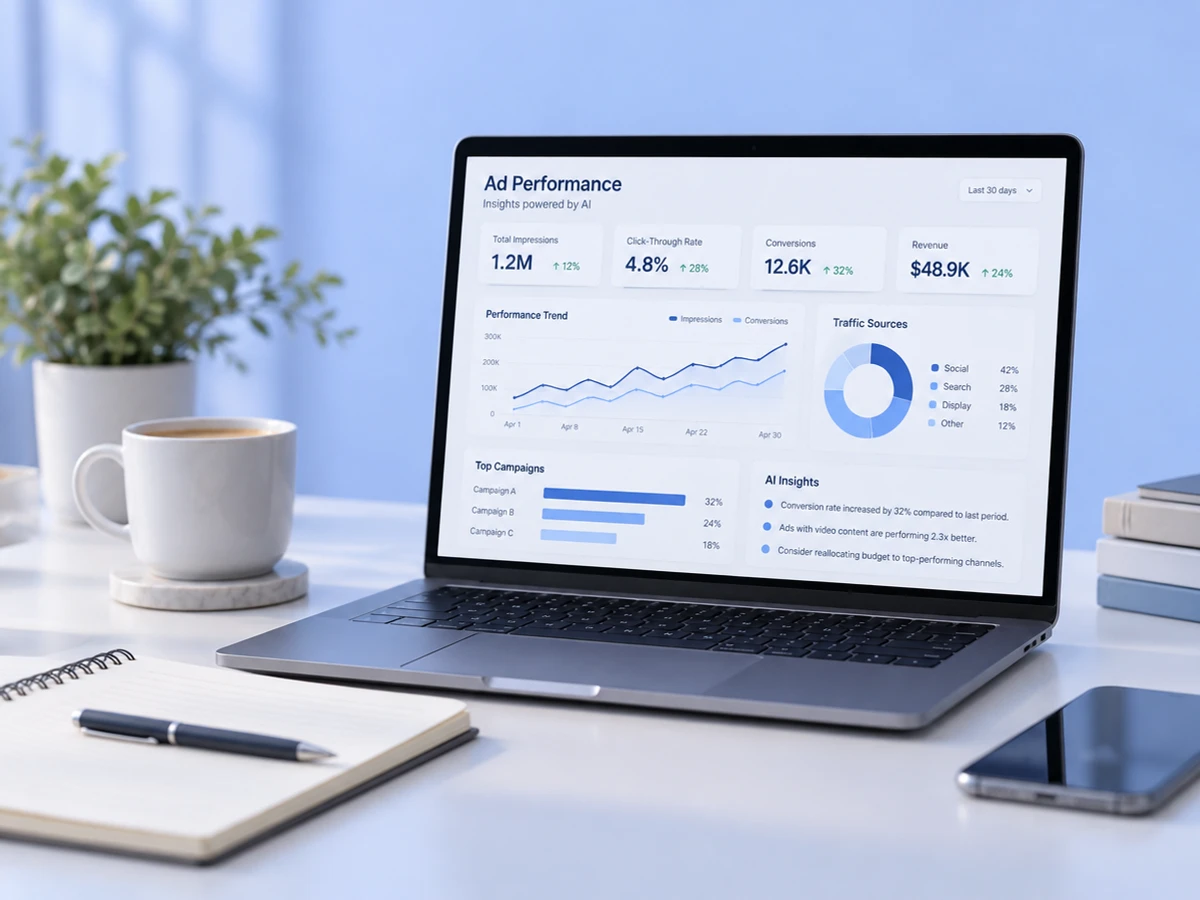
how to choose an AI-powered native advertising agency for your D2C brand in 2026 | Updated October 2026 | Klickrocket Team | 25-35 minutes to read, 2-4 weeks to evaluate and select | Beginner
What You'll Learn
Choosing an AI-powered native advertising agency for your D2C brand comes down to four things: how fast they produce creative, how strong their data model is, how quickly they launch and iterate campaigns, and whether they offer real managed service support. Don't let a long client logo wall make the decision for you. Native advertising is a massive channel, with US marketers investing $147.98 billion into native display in 2026, a 13.1% year-over-year increase. For most competitive D2C brands, AI is now the operating layer everything else runs on. This guide gives you a repeatable way to vet agencies so you don't get locked into a long contract with a partner still testing creative by hand.
- How to turn your growth goals into concrete evaluation criteria before you take a single sales call.
- How to audit an agency's AI tooling and creative pipeline, beyond the pitch deck.
- How to test launch speed and managed-service readiness through a real pilot.
- How to compare pricing models so you don't pay agency margin on top of ad spend you could manage yourself.
Before you start, gather at least 3-6 months of historical ad performance data (from Meta, TikTok, or native networks), a defined monthly ad budget, and a target Customer Acquisition Cost (CAC) or Return On Ad Spend (ROAS).
Why Choosing the Right AI Native Ad Agency Matters in 2026
Native advertising is where consumer attention lives. Banner ads have lost ground to "banner blindness," the habit people have of tuning out anything that looks like a banner, while in-feed and native formats keep pulling bigger budgets. US programmatic display spend is projected to exceed $200 billion in 2026, with native advertising capturing a significant portion of that growth. At the same time, 83% of ad executives say their company has deployed AI in the creative process, up from 60% in 2024, according to research by IAB and Sonata Insights.
For D2C brands, the wrong partner now costs more. Agencies that rely on manual creative testing can't keep up with AI-personalized native advertising, which generated $43.1 billion, roughly 38.4% of total native ad spend in 2026. Adoption inside agencies is still uneven. A 2026 Forrester and 4A's study found that 61% of agencies still treat AI as a cost of doing business with limited direct monetization. Many are bolting AI onto old workflows instead of rebuilding around it.
That gap between "AI-washed" agencies and truly AI-native partners is why a structured evaluation matters. The D2C brands compounding performance fastest in 2026 chose partners whose data model, creative pipeline, and launch speed were built for AI from the start.
Key Takeaway: AI-native agencies are essential for D2C brands that want to keep pace with native advertising's growth and move past the limits of manual creative testing. For supporting data, see 10 B2B Marketing Agencies Using Proprietary AI to ....
The Process at a Glance
| Step | Action | Time | Outcome |
|---|---|---|---|
| 1 | Define evaluation criteria and KPIs | 2-3 days | Clear scorecard to compare agencies |
| 2 | Audit AI stack and creative pipeline | 3-5 days | Understand real automation versus marketing hype |
| 3 | Evaluate the data and learning model | 2-4 days | Confidence in compounding performance gains |
| 4 | Run a paid pilot campaign | 2-3 weeks | Proof of launch speed and managed service quality |
| 5 | Compare pricing and contract terms | 1-2 days | Agreement that scales with results, not just spend |
Total time: roughly 3-4 weeks from first scoping call to signed contract.
Step 1: Define Your Evaluation Criteria and KPIs Before You Start Shopping
Agency pitches are polished by design, so without your own yardstick, the best presenter usually wins.
What You're Doing
Write a scorecard that defines what "good" looks like for your brand, so every pitch is measured against the same standard.
How to Do It
- List your top 2-3 business Key Performance Indicators (KPIs), such as Customer Acquisition Cost (CAC), blended Return On Ad Spend (ROAS), or new-customer revenue, and record the current baseline for each.
- Decide which native channels matter most: in-feed social, content recommendation widgets like Taboola or Outbrain, or app-install networks.
- Write down your non-negotiables: minimum weekly ad output, reporting cadence, and whether you want a fully managed service or a self-serve platform with support.
- Score each agency from 1 to 5 on every criterion as you go through the calls.
Common Mistakes
Case studies from a different category or a much bigger budget can be misleading. A $50,000 per month supplement brand's results tell you little about a $5,000 per month skincare launch. Always ask for comparable-spend, comparable-category benchmarks.
What Done Looks Like
You have a one-page, weighted scorecard that anyone on your growth team can use to score a pitch in under 10 minutes.
Key Takeaway: A clear scorecard built on specific KPIs and non-negotiables keeps your evaluation objective. For a more detailed walkthrough, see How to Choose the Right Digital Marketing Agency (2026 ....
Step 2: Audit the Agency's AI Stack and Creative Production Pipeline
Plenty of agencies have slapped "AI-powered" on their homepage. The fastest way to tell the difference is to look under the hood.
What You're Doing
You're separating agencies that rebuilt their workflow around AI from those that added the label to a traditional creative team. Only 56% of marketing professionals had AI in production as of early 2025, so ask for proof rather than taking anyone's word for it.
How to Do It
- Ask exactly which parts of the pipeline are automated: brief generation, scriptwriting, video assembly, localization, or just reporting dashboards.
- Request a live demo of their creative generation tool rather than a pre-recorded reel.
- Ask how many net-new ad variations they can produce per week per account, and what each one costs.
- Check whether their ad intelligence flags competitive gaps, meaning angles your competitors run that you haven't tested.
Best Practices
Klickrocket is built around this gap. It's an AI-native performance marketing platform where ad intelligence agents monitor performance around the clock, flag where competitors are ahead, and recommend the next ads to make. Its creative generation agents produce full ad briefs, scripts, and finished ads without in-house creative talent. We believe creative is the real differentiator once ad buying is largely automated, so we built our tools to keep marketers in control.
Common Mistakes
"We use ChatGPT for our copy" is not an AI-native pipeline. Ask who makes the creative calls, who signs off, and how fast a losing ad gets swapped out. A true AI-native pipeline uses AI across the whole creative lifecycle.
What Done Looks Like
You can explain in plain language which steps run on automation and which still need a human.
Key Takeaway: Ask for a live demo of the agency's AI creative tools and map which steps are automated, so you can verify the AI is doing real work.
Talk to Us!
The fastest way to know if this works for your brand is to see 5 ads built for it. Build them in minutes, upload to Google and Meta ads manager. Watch the ads perform. FREE
Book a DemoStep 3: Evaluate the Data and Compounding Learning Model
Once an agency can produce creative quickly, the next question is whether it gets smarter over time. An agency that starts from zero with every new client never builds much momentum.
What You're Doing
A strong AI-native agency should improve every week because its model learns from every ad it runs across every client, not just your account in isolation. This compounding learning model is the biggest difference between agencies that plateau and those that keep stacking gains.
How to Do It
- Ask how the agency's model shares learnings across accounts, versus starting fresh with each new client.
- Ask for a concrete example: a hook or format discovered on one account that worked on another in the same category.
- Check how quickly underperforming creative gets flagged and replaced: hours, days, or weeks?
- Confirm the intelligence layer tracks competitor creative too, not just your own account data.
Example
| Agency Type | Learning Model | Typical Weekly Output |
|---|---|---|
| Traditional creative shop | Manual review, starts fresh per client | 3-5 new ad variants |
| AI-assisted hybrid | AI drafts, humans approve slowly | 8-12 new ad variants |
| AI-native platform (e.g. Klickrocket) | Model compounds across accounts weekly | 20+ new ad variants |
What Done Looks Like
You can name a specific mechanism, not a buzzword, that makes the agency's intelligence improve week over week, and you've seen evidence it works.
Key Takeaway: Favor agencies with a compounding learning model that carries insights across clients, so performance keeps improving.
Step 4: Run a Paid Pilot to Test Campaign Launch Speed and Managed Service Quality
Steps 1 through 3 show what an agency says and how its tools work. A pilot shows how it behaves when money is on the line.
What You're Doing
A 2-3 week paid test reveals more about launch speed, communication quality, and managed-service reliability (the agency handling day-to-day campaign management and optimization for you) than any number of reference calls.
How to Do It
- Agree on a fixed pilot budget (typically $3,000-$10,000 for a D2C brand) and a clear success metric tied to your Step 1 KPIs.
- Time the gap from kickoff to first live ad. It should be days, not weeks.
- Watch whether the team monitors performance on its own or waits for you to raise issues.
- Ask directly how the managed service works: do human strategists review AI-generated creative and campaign decisions, or does everything run on autopilot?
Best Practices
Look for AI agents handling repetitive monitoring and optimization around the clock, with a human staying in the loop for strategic calls. That's the model Klickrocket uses for its managed service, with creative generation that runs the full production pipeline from a single request. The goal is high-quality, human-feeling ads delivered faster and at a more reasonable cost than a traditional agency build.
Common Mistakes
Running a pilot on a tiny budget, say under $1,000, is a common trap. The algorithm gets too little data to show how fast it can learn, so you end up judging the agency on noise.
What Done Looks Like
You have real campaign data covering launch speed, creative iteration rate, and how responsive the team was.
Key Takeaway: A paid pilot with a realistic budget is the most reliable way to check launch speed, managed service quality, and creative iteration.
Step 5: Compare Pricing Models and Contract Flexibility
Pricing decides how much of your budget reaches the ads themselves, so it deserves the same scrutiny as the creative.
What You're Doing
Get clear on what you're paying for: a flat retainer, a percentage of ad spend, or a platform subscription plus an optional managed service.
How to Do It
- Ask for a full cost breakdown: platform fee, management fee (often 10-20% of ad spend), and any creative production add-ons.
- Check contract length and cancellation terms. For a first engagement, month-to-month is much safer than a locked 12-month deal.
- Confirm whether creative production is capped at a fixed number of ads per month or scales with spend.
- Ask what happens to your performance data and creative assets if you leave. You should always keep ownership of them.
Common Mistakes
Signing a long contract before you've seen a full billing cycle is one of the costliest mistakes D2C brands make. Insist on an initial term of 60-90 days that you can exit cleanly if KPIs aren't met.
What Done Looks Like
You have a signed agreement whose pricing and exit terms you fully understand, with no hidden markup on ad spend or creative production.
Key Takeaway: Push for flexible terms tied to performance, with a clean exit if KPIs aren't hit.
What to Do After Choosing Your AI Native Advertising Agency
Signing is the start, not the finish. How you handle the first few months determines whether the agency's advantages show up in your numbers.
Phase 1 (Weeks 1-4): Onboarding and baseline. Share historical data, agree on a reporting cadence, and confirm the agency has ingested your past performance before you scale spend.
Phase 2 (Months 2-3): Scale what's working. Put more budget behind winning creative formats, and ask the agency to show the signals (Click-Through Rate, hook rate, thumb-stop) behind its recommendations.
Phase 3 (Months 4+): Expand channels and compound learnings. Once native performance is steady, apply the same AI-driven creative model to adjacent channels so your data advantage grows across your media mix.
Key Takeaway: Follow a phased plan after you sign: onboard carefully, scale the creative that proves itself, then expand the learnings into other channels.
Resources You'll Need
| Resource | Role | Requirement | Price |
|---|---|---|---|
| Klickrocket | AI native performance marketing platform and managed Meta campaign service with compounding creative intelligence | Recommended | Custom pricing |
| Taboola | Open-web native ad network for content discovery | Recommended for native reach | CPC/CPM, varies |
| Outbrain | Alternative native ad network for publisher placements | Optional | CPC/CPM, varies |
| IAB (Interactive Advertising Bureau) | Industry benchmarks and native ad format standards | Recommended research source | Free |
| eMarketer | Spend forecasts and benchmark data for negotiation leverage | Optional | Free summaries, paid reports |
See also, see The 4 Best AI Marketing Agencies in 2026 (Including ....
Common Plateaus & How to Break Through
Plateau: Creative output is slow and expensive
Likely cause: The agency relies on manual video editing and copywriting instead of an automated creative generation pipeline.
Fix: Ask for proof of brief-to-ad turnaround time. A genuinely AI-native workflow turns out new variants in days, not weeks.
Plateau: Performance improves early, then stalls
Likely cause: The model isn't learning across accounts or categories, so it runs out of ideas once the obvious wins are tested.
Fix: Confirm the intelligence layer tracks competitive creative gaps and surfaces new angles, not just A/B tests inside your existing ad set.
Plateau: You feel out of the loop
Likely cause: Reporting arrives as a monthly PDF instead of live dashboards, common at agencies bolting AI onto legacy processes.
Fix: Require real-time or weekly dashboard access, and ask who (or what agent) watches your account every day.
Plateau: Costs keep climbing without clear ROI
Likely cause: A pure percentage-of-spend model means the agency earns more the more you spend, whether or not it's efficient.
Fix: Negotiate pricing tied to output or outcomes, such as ads produced or CAC targets hit, instead of a straight percentage of spend.
Key Takeaway: Head off plateaus by asking for proof of AI automation, cross-account learning, real-time reporting, and performance-based pricing from the start. For more troubleshooting advice, see Brand.
Conclusion
Choosing an AI-powered native advertising agency for your D2C brand in 2026 is about testing, not trusting. Define your criteria, audit the real AI pipeline, confirm the data model improves over time, run a proper pilot, and only then negotiate pricing and terms.
Key Takeaways
- A structured five-step evaluation (criteria, AI audit, data model, pilot, pricing) keeps you away from agencies that are AI-branded but not AI-native.
- The agencies winning in 2026 have creative intelligence and production pipelines that compound week over week, not the longest client rosters.
- Your next move: build your one-page scorecard from Step 1 before you take another agency sales call.
FAQ
How do I choose an AI-powered native advertising agency for my D2C brand?
Start by defining your KPIs and non-negotiables. Audit each candidate's actual AI creative pipeline, and check whether their data model shares learnings across accounts. Run a paid pilot for 2-3 weeks to test launch speed and managed service quality, then compare pricing and contract flexibility before you sign. The full process, covered in How to Choose an AI-Powered Native Advertising Agency for Your D2C Brand: Step-by-Step Guide (2026), usually takes 3-4 weeks from first call to signed contract.
What makes an advertising agency "AI-native" versus just "AI-powered"?
An AI-native agency has built its core workflow, including briefing, production, monitoring, and optimization, around AI agents from the ground up. An "AI-powered" agency has usually added AI tools on top of an existing manual process. The clearest signs are speed and scale: AI-native agencies produce dozens of ad variants a week and react to performance changes within hours.
How much does an AI native advertising agency cost for a D2C brand?
Pricing varies, but most agencies charge a management fee, typically 10-20% of ad spend, sometimes plus a platform or creative production fee. Smaller D2C brands running pilots often budget $3,000-$10,000 for an initial test.
What is native advertising and why does it matter for D2C brands in 2026?
Native advertising is paid media that matches the look and feel of the platform it appears on, like an in-feed social ad or a content recommendation widget, instead of looking like a traditional banner. It matters because US native display spending is projected to reach $147.98 billion in 2026, a 13.1% year-over-year increase, making it one of the fastest-growing ways to reach D2C customers where they already spend their attention.
How do I know if an agency's AI creative is actually working?
Ask for a pilot with clearly defined KPIs tied to your baseline. Track creative output volume, cost per new variant, and how quickly losing ads get replaced. A working AI system should show measurable improvement in cost-per-engaged-visit or Click-Through Rate (CTR) within the first 2-3 weeks of a properly funded pilot.
Should I choose a fully managed service or a self-serve AI ad platform?
It depends on your team's bandwidth. A managed service, where AI agents handle monitoring and optimization with a human strategist overseeing the work, suits lean D2C teams without in-house creative or media buying experience. A self-serve platform makes more sense if you already have strategists and mainly need faster creative production.
What red flags suggest an agency is not actually AI-native?
Watch for an inability to demo tools live, vague answers about how creative decisions get made, slow turnaround (weeks instead of days) for new ad variants, and case studies that highlight vanity metrics like impressions instead of Customer Acquisition Cost (CAC) or Return On Ad Spend (ROAS).
How long does it take to see results after switching to an AI native agency?
Most D2C brands see initial performance signals within the first 2-3 week pilot. Meaningful compounding gains usually appear by month two or three, as the agency's model learns from your data alongside its cross-account learnings.
This guide is based on publicly available 2025-2026 industry research from sources including eMarketer, IAB, Forrester, and 4A's, combined with general best practices for evaluating performance marketing partners. Figures and benchmarks cited are sourced from the respective publishers as linked throughout the article; individual results vary by brand, category, and spend level. This article was produced by Klickrocket and may reference Klickrocket's own products and services alongside independent third-party resources.